What a GST invoice must legally contain (and the HSN rule for small shops)
The fields a GST tax invoice is required to carry under Rule 46, the HSN code digits you must show based on turnover, when a bill of supply replaces a tax invoice, and the turnover at which you must register for GST.
A GST bill isn’t just a receipt with tax on it. The rules spell out exactly what a tax invoice has to carry, and a bill that’s missing pieces can cost your buyer their input tax credit and leave you out of step with your own returns. The good news is the list is finite and most of it is the obvious stuff. Here’s what’s required and the couple of details that trip up small shops.
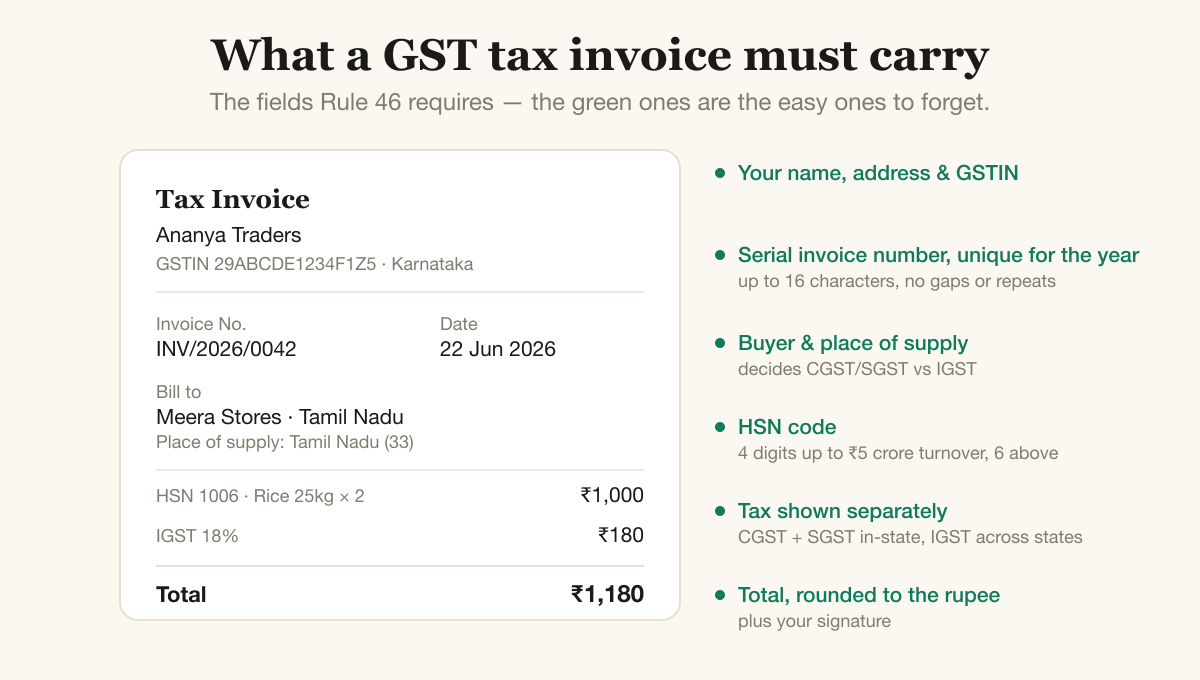
The fields a GST tax invoice must carry under Rule 46. The serial number, HSN code, and place of supply are the ones most often missed.
What a tax invoice must show
Rule 46 of the CGST Rules sets the required fields. On every tax invoice you should have:
- Your business name, address, and GSTIN
- An invoice number — a consecutive serial, unique within the financial year, up to 16 characters, using only letters, numbers, hyphens, and slashes
- The invoice date
- The buyer’s details (name and address; their GSTIN too if they’re registered)
- The place of supply, and the buyer’s state, for inter-state sales
- The HSN code for goods, or SAC code for services (how many digits depends on your turnover — see below)
- A description of what was sold, with quantity and unit
- The taxable value, after any discount
- The tax rate and tax amount, shown separately as CGST and SGST, or as IGST
- The total amount due
- Whether tax is on a reverse-charge basis
- Your signature or digital signature
Most billing tools fill in the bulk of this for you. The two fields people actually get wrong are the invoice number and the HSN code.
The invoice number has rules
It has to be a running serial, unique inside the financial year. You can reset it to 1 at the start of each year or carry it on — either is allowed. You can run separate series for different counters or branches, as long as each series doesn’t repeat a number within the year. What you can’t do is skip numbers, duplicate them, or invent one per bill at random, because gaps and repeats are exactly what make a GST return fail to reconcile.
The HSN code, by turnover
HSN codes classify goods; SAC codes classify services. How many digits you must print depends on your turnover in the previous financial year:
| Turnover (previous year) | HSN digits on a business-to-business bill |
|---|---|
| Up to ₹5 crore | 4 digits |
| Above ₹5 crore | 6 digits |
For a small shop, that means a 4-digit HSN code is what you need on a B2B bill. On a bill to an ordinary consumer (B2C), showing HSN is optional below ₹5 crore turnover — though putting it on does no harm and keeps your records consistent. Exporters are a separate case and use the full 8-digit code.
Tax invoice or bill of supply?
Not every seller issues a tax invoice. You issue a bill of supply instead — which looks similar but carries no GST line — in two situations:
- You’re registered under the composition scheme, where you pay GST at a flat rate out of your own pocket and aren’t allowed to collect it from customers.
- You only sell exempt goods, where there’s no GST to charge.
A bill of supply doesn’t let your buyer claim input tax credit, because no GST changed hands. If you charge GST, you issue a tax invoice; if you can’t or don’t, it’s a bill of supply.
Do you even need to register for GST?
If your turnover is below the threshold, GST registration is optional and you can run on plain bills without any of this. The current limits are:
| What you supply | Most states | Special-category states |
|---|---|---|
| Goods | ₹40 lakh | ₹20 lakh |
| Services | ₹20 lakh | ₹10 lakh |
A few situations force registration whatever your turnover — the common one for a small shop is making taxable sales to another state, or selling through an e-commerce platform. Those require GST registration even if you’re well under the limit.
Getting every field on, every time
The fields that matter most for compliance — the serial invoice number, the HSN code, the CGST/SGST or IGST split, the place of supply — are also the easiest to forget on a handwritten bill or a generic template. Kwibo lays them out in the right places on a proper GST tax invoice, keeps the numbering consecutive, and works out the tax split from the states involved. It’s free and needs no login, and the bill prints in the language your customer reads, so the document they’re handed is one they can actually check. You fill in your business once; every bill after that comes out complete.