GST rates in 2026: the new slabs after the September 2025 reform
India's GST slabs changed on 22 September 2025. The old 5/12/18/28 structure is gone — here are the current rates, what moved where, and how to find the right rate for what you sell.
If you learned GST a few years ago, the rates in your head are probably out of date. On 22 September 2025 the GST Council put through a reform widely called GST 2.0, and it threw out two of the four slabs everyone had memorised. The 12% and 28% rates no longer exist. A lot of online guides, and plenty of billing apps, still quote them. This is what the rates actually look like now.
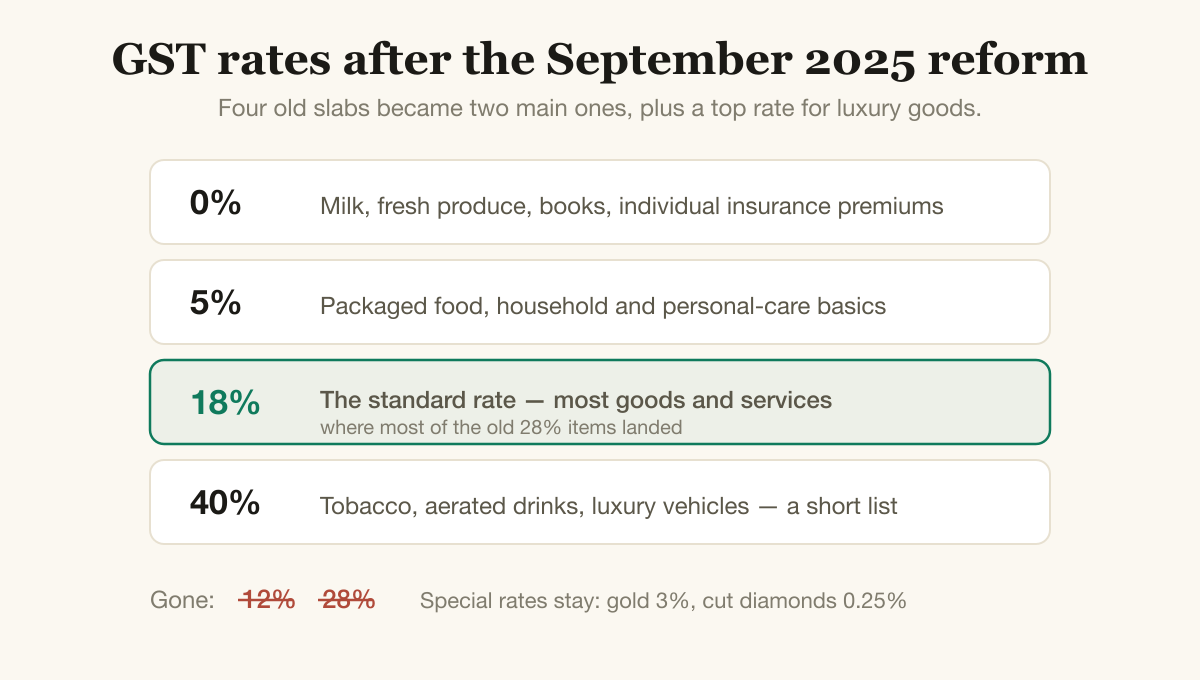
Four old slabs became two main rates, plus a 40% top rate for luxury and sin goods. The 12% and 28% slabs are gone.
The slabs as they stand
There are now two main rates, plus a nil rate, a high rate for a short list of goods, and a couple of special rates for precious metals.
| Rate | What it’s for |
|---|---|
| 0% (nil) | Everyday essentials — unpackaged staples, fresh produce, milk, and a longer list than before |
| 5% | Common household and merit goods |
| 18% | The standard rate for most goods and services |
| 40% | Luxury and “sin” goods — a small, specific list |
| 3% | Gold, silver and platinum |
| 0.25% | Cut and polished diamonds |
The headline change is that the old middle slab of 12% and the old top slab of 28% were removed. Most things that sat at 12% dropped to 5%; most things at 28% dropped to 18%. A narrow set of luxury and sin items moved up into the new 40% slab.
What sits where
The rates are tied to specific goods, so the only fully reliable answer for your product is the official rate (more on finding it below). But to give you the shape of it:
Nil (0%). Fresh vegetables and fruit, milk, eggs, unpackaged staples like loose rice and wheat, books and newspapers. The 2025 reform added more here: individual health and life insurance premiums, which used to carry GST and now don’t, along with a list of essential medicines and basic school stationery like pencils and notebooks.
5%. A wide band of everyday goods — packaged foods, many personal-care basics, household items, and a range of things that came down from the old 12% slab.
18%. The default for most of what a general shop sells, and for most services. A large share of what used to be taxed at 28% — many appliances and electronics among them — now sits here.
40%. A deliberately short list: tobacco and pan masala, aerated and energy drinks, high-end vehicles, and a few other luxury and demerit categories. Most shops will never touch this slab.
Gold and diamonds. Gold, silver and platinum stay at 3%, and cut and polished diamonds at 0.25% — both left exactly as they were by the reform.
Nil, exempt, and “no GST” aren’t the same thing
On the customer’s bill these all look identical: no tax charged. The difference matters to you as the seller, not to the buyer.
A nil-rated good has a GST rate that is genuinely 0%. An exempt supply is one the government has specifically kept out of GST. In both cases you charge no tax, and in both cases you generally can’t claim back the GST you paid on related inputs. A few things — alcohol for human consumption, petrol and diesel — sit outside GST entirely and run on separate state taxes. For day-to-day billing the practical point is simple: if what you sell is nil-rated or exempt, your bill shows the value with no tax line.
How to find the right rate for what you sell
Rates attach to a product’s HSN code, the standard classification number for goods (services use a SAC code). Two products with similar names can sit in different slabs, so guessing from the name is risky.
The authoritative source is the government’s own rate finder on the CBIC GST portal, where you can search by product description or HSN code and get the current rate. If you sell a steady set of products, it’s worth looking each one up once and noting the rate down, rather than re-deciding on every bill.
A caution on timing
GST rates can change at any GST Council meeting, and the Council meets a few times a year. The structure above reflects the September 2025 reform and the position through the first half of 2026. If you’re reading this much later, check the current rate before relying on it, and treat any source still listing 12% or 28% as a current GST rate as out of date.
Once you know the rate, the bill is the easy part
Knowing the rate is the hard part. Applying it shouldn’t be. Kwibo takes the rate you set for a product, works out the tax, splits it into CGST and SGST within your state or charges IGST across states, and lays it all out on a clean GST bill — in the language your customer reads. It’s free and needs no login. You bring the rate; it does the arithmetic and the formatting.